From Reactive Medicine to Predictive Healthcare: How AI Is Reshaping Healthy Longevity
Prediction is one of AI’s core capabilities, whether it is mining an image to identify a lesion or guessing the next word in an LLM. And prediction is one of the most important features of the 4P model of healthcare towards which we should be building – Prediction, Prevention, Personalisation and Participation.
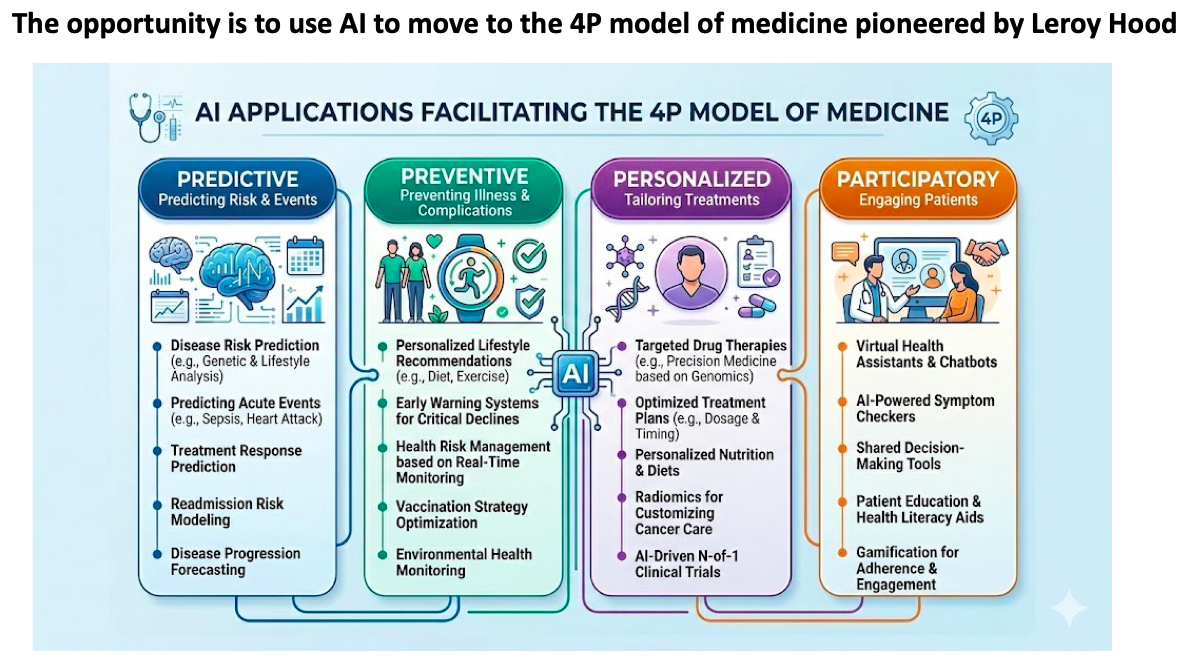
In a recent talk to a Lithuanian longevity conference, I laid out how this new power can enable us to take the right actions to secure a healthier lifespan, especially when combined with the growing body of diagnostic biomarkers that give us insight into early dysfunction or disease in our various body systems.
For example, liquid biopsy tests can detect circulating tumour cells, or their DNA fragments, that point to the potential of a tumour long before actual symptoms appear – just the point at which we can have the greatest impact on the future of the disease, provided we can keep false positives (with their implications for unnecessary workups) to a minimum.
Sometimes the data on which AI operates was collected for a quite different purpose.
Two examples:
Back-of-the-eye OCT images collected to track ocular health can reveal cardiovascular risk.
And, in an example shared by Eric Topol in a recent blog, data on 10,000 patients collected to assess the response of their cardiovascular system to an auto-immune therapy (Interleukin-1 beta) actually revealed that the medicine dramatically cut the risk of fatal lung cancer.
This is the tip of an iceberg.
Hidden in many clinical trial and routine treatment databases are many drug repurposing opportunities, if AI can be pointed in the right direction.
One of my companies, Metadvice, applying its distinctive neural network technology to NHS primary care data, can tell clinicians, for a patient with a cardiometabolic disorder (say high lipids), the probability that they will go on to develop a second cardiometabolic condition in the next three years (with a sensitivity of 60–75%).
Clinically, of course, this should not surprise us, as for many patients metabolic syndrome underlies a range of diseases that may appear in a different order in different individuals.
Most recently, the company has turned its attention to heart failure and found that the software can identify incipient or early-stage heart failure much more readily than hard-pressed or inexperienced clinicians, enabling the right referral to be made early in the disease’s course.
It can also tell a sceptical clinician the major factors that lead to that conclusion.
Some will not surprise her – age and BMI, for example – but others, like LDL, sodium and serum albumin, may not be on her radar screen in that context.
And AI can also predict the rate of worsening of a condition – this has been established for both chronic kidney disease and the even more life-threatening sepsis.
So far, most analysis has been based on typical blood test results.
AI will help us gain even deeper insights when these are combined with wearables, dietary inputs, continuous glucose monitor data, sleep scores and the like.
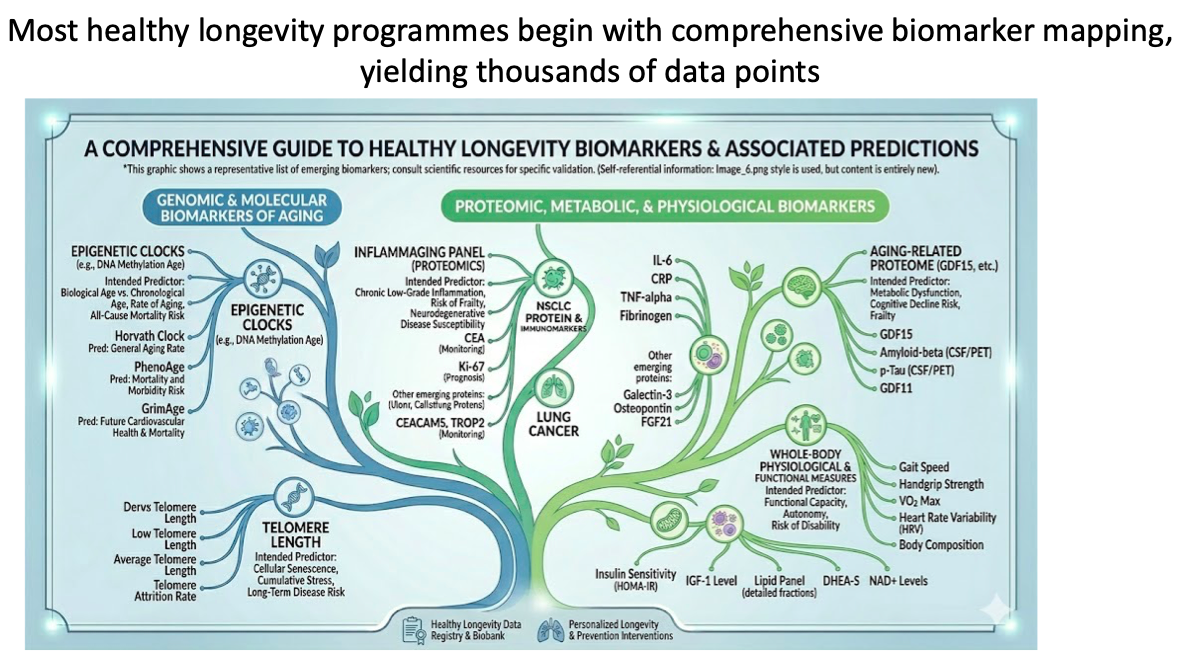
With literally hundreds of markers and thousands of through-time data points, showing different patterns in different individuals, there is no way the human brain could disentangle them at scale and in a personalised manner.
AI therefore has an inescapable role in helping healthy longevity programmes become data-driven rather than fad-focused.
In many ways, the new power of AI reflects the limitations of conventional medicine, with its focus on averages, typical ranges, presenting problems and rule-of-thumb remedies.
Most healthy longevity programmes begin with comprehensive biomarker mapping, yielding thousands of data points.
Of course, the greatest power comes from combining AI’s analytical strengths with the insights and human empathy of a seasoned clinician – the best of both worlds!
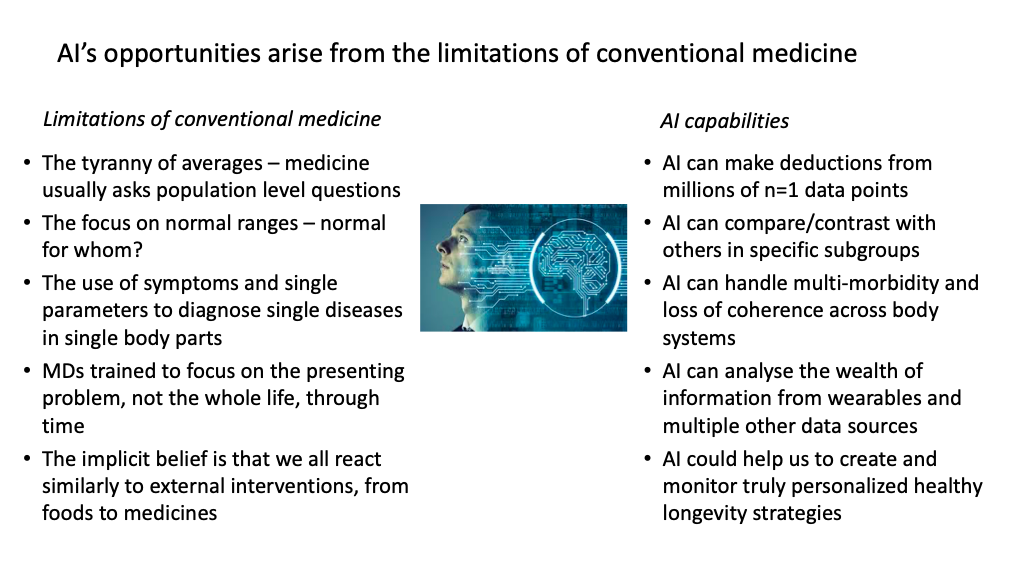
Image: Prof Richard Barker